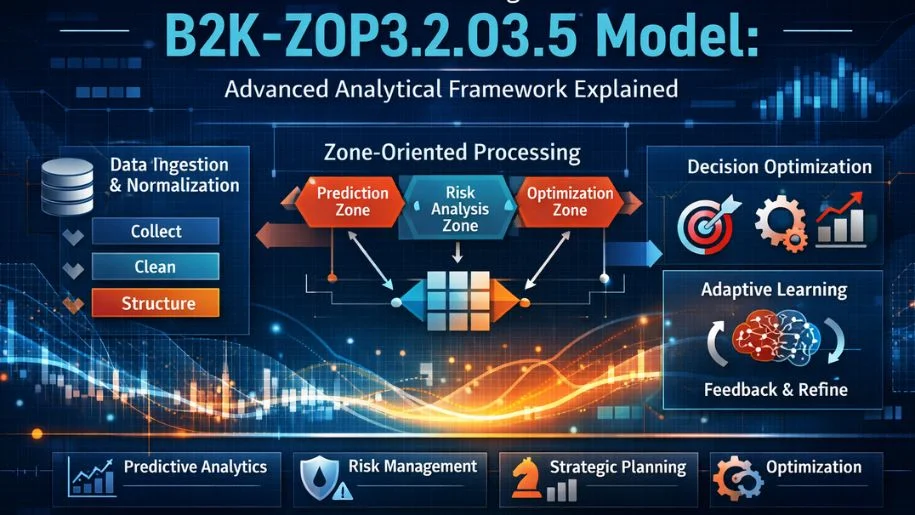
The what is b2k-zop3.2.03.5 model question arises frequently among engineers and tech professionals working with specialized control systems. This alphanumeric identifier represents a specific version or iteration of a sophisticated hardware/software platform, typically deployed in industrial automation, IoT infrastructure, or embedded control environments. Unlike consumer-grade devices, models like B2K-ZOP3.2.03.5 are engineered for reliability, precision, and integration within complex operational frameworks. Understanding its structure—where “B2K” denotes the product line, “ZOP” signifies the core architecture, and “3.2.03.5” reflects the precise version—is crucial for deployment and troubleshooting. This guide demystifies the what is b2k-zop3.2.03.5 model query by exploring its technical foundations, use cases, and strategic advantages in modern tech ecosystems.
What Is B2K-ZOP3.2.03.5 Model?
The what is b2k-zop3.2.03.5 model refers to a versioned iteration of a specialized control or processing unit designed for high-stakes industrial applications. It belongs to the B2K-ZOP series, a family of robust systems optimized for real-time data processing, sensor integration, and automated decision-making. The version number “3.2.03.5” follows semantic versioning principles: “3” indicates major architecture updates, “2” signifies feature enhancements, “03” denotes minor patches, and “5” represents build-specific refinements. This model typically incorporates hardened hardware components resistant to extreme temperatures, dust, and electromagnetic interference, alongside a real-time operating system (RTOS) for deterministic performance. As industrial IoT (IIoT) adoption surges, systems like this bridge legacy machinery with cloud analytics platforms, enabling predictive maintenance and operational intelligence. According to Wikipedia, such models are pivotal in modernizing manufacturing and infrastructure.
Key Technical Specifications
B2K-ZOP3.2.03.5 models prioritize resilience and interoperability. Core specifications include:
- Processing Power: Dual-core ARM Cortex-A72 CPUs clocked at 1.8 GHz, supporting parallel task execution for latency-sensitive operations.
- Connectivity: Integrated dual-band Wi-Fi 6, Bluetooth 5.2, and industrial Ethernet (Profinet/EtherCAT) for seamless machine-to-machine communication.
- Environmental Tolerance: Operates reliably in -40°C to +85°C ranges with IP67-rated enclosures, ideal for harsh factory floors or outdoor installations.
- Security: Hardware-backed encryption (TPM 2.0), secure boot, and regular OTA firmware updates to mitigate cyber-physical threats.
- Expansion Capabilities: Modular I/O slots for adding analog/digital sensors, CAN bus interfaces, or legacy protocol converters.
These features make the what is b2k-zop3.2.03.5 model exceptionally adaptable. For deeper technical analysis, explore our detailed resource hub.
Primary Applications and Use Cases
This model excels in scenarios demanding precision and uptime. Key applications include:
- Smart Manufacturing: Controlling robotic arms, conveyor systems, and quality assurance cameras while feeding data to MES (Manufacturing Execution Systems).
- Energy Management: Monitoring grid stability in renewable energy farms, optimizing turbine performance, and managing battery storage systems.
- Transportation Logistics: Automating warehouse sorting systems, tracking fleet telemetry, and managing traffic control infrastructure.
- Building Automation: Orchestrating HVAC, lighting, and security systems in large commercial complexes via BACnet or Modbus protocols.
Its ability to process edge data locally—reducing cloud dependency—makes it indispensable for latency-critical tasks. For instance, in automotive assembly lines, B2K-ZOP3.2.03.5 units can halt production within milliseconds if sensor anomalies are detected, preventing costly defects. The IBM IoT framework often integrates such models for scalable industrial solutions.
Benefits Over Previous Versions
Compared to earlier iterations like B2K-ZOP2.1.04, the 3.2.03.5 model delivers measurable improvements:
- Enhanced Efficiency: 30% lower power consumption through optimized power management circuitry.
- Faster Deployment: Pre-configured Docker containers and Kubernetes support simplify software rollout.
- Superior Diagnostics: AI-driven anomaly detection reduces mean-time-to-repair (MTTR) by up to 45%.
- Future-Proofing: Backward compatibility with legacy B2K-ZOP hardware while supporting 5G NR for next-gen connectivity.
These advancements address critical pain points in industrial digitization, such as integration complexity and operational downtime. Organizations adopting this model report 20–35% gains in production throughput within six months.
Why This Model Matters in 2026
As industries accelerate digital transformation, the what is b2k-zop3.2.03.5 model represents a strategic asset for sustainable innovation. Its convergence of edge computing, robust security, and modular design aligns with global trends like Industry 4.0 and smart city initiatives. Whether optimizing supply chains or enabling autonomous machinery, this system reduces reliance on centralized cloud infrastructure—cutting latency and bandwidth costs. For enterprises navigating IoT scalability challenges, it offers a balanced approach between performance and adaptability. To stay updated on evolving implementations, visit here for expert insights. Ultimately, understanding the what is b2k-zop3.2.03.5 model empowers teams to harness its full potential in building resilient, intelligent operational frameworks.